3D Cameras
In 2015, Konstantin founded Nerian Vision, a manufacturer of high-speed 3D cameras. Over the following years, he led the development of four product generations, combining stereo vision with ultra-fast FPGA-based image processing to deliver real-time 3D depth measurements. As founder and lead developer, he was directly responsible for FPGA design, electronics development, and a significant share of the software stack.
Nerian’s cameras were deployed in more than 35 countries, providing reliable and precise 3D measurements for a wide range of machine vision applications. In 2022, the company was acquired by a major player in the machine vision industry and integrated into their existing portfolio. All cameras were based on Zynq UltraScale+ MPSoCs, leveraging the combination of programmable logic and embedded processing for high-speed, low-latency 3D imaging.
Ruby 3D Camera
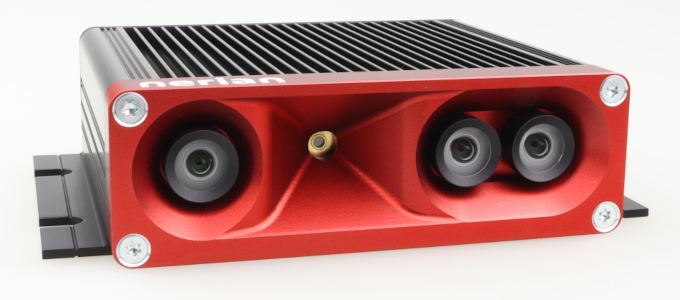
The Ruby camera represents the final generation of Nerian’s product line, combining the best features of stereo vision and structured light. It features:
- Three image sensors: two monochrome sensors for depth perception and one color sensor
- Infrared pattern projector: improves depth perception without affecting the color sensor
- Measuring range from 33 cm with a 62° field of view
- Inertial sensor and laser pattern projector
- Sensor format: monochrome and color
- Maximum resolution: 1.5 MP
- Maximum disparity: 256 pixels
- Maximum frame rate: 60 fps
By integrating stereo vision with structured light, Ruby delivers flexible, high-speed 3D measurements suitable for challenging lighting conditions and long measurement distances, while maintaining precision even on textureless surfaces.
Technical Innovations
The Nerian Vision family of 3D cameras was a driving force in advancing real-time 3D sensing technology. The product line comprised three stereo-vision solutions – Ruby, Scarlet, and SceneScan – all built around the same hardware-accelerated image-processing pipeline developed by Konstantin Schauwecker. Their key capabilities included:
- Hardware-accelerated image rectification using DMA and a custom cache
- Image pre-processing for optimal depth estimation
- A highly parallelized stereo-matching engine based on the Semi-Global Matching (SGM) algorithm
- Post-processing of the computed 3D cost volume and reduction to a disparity map
- Advanced disparity-map filtering for improved accuracy
- Fully end-to-end processing inside the FPGA, enabling deterministic, low-latency performance
This FPGA-based processing was complemented by an embedded-Linux software stack responsible for control flow, network communication, configuration, calibration, and an intuitive web-based user interface.
Nerian’s sensors were also defined by their custom electronics and compact mechanical design. Each device integrated substantial compute capability and high-performance components in a small form factor. This approach reached its peak with the Ruby sensor, which packed a powerful FPGA, three image sensors with optics, and a laser pattern projector into a housing measuring just 130 × 92.5 × 34.5 mm and weighing 450 g.
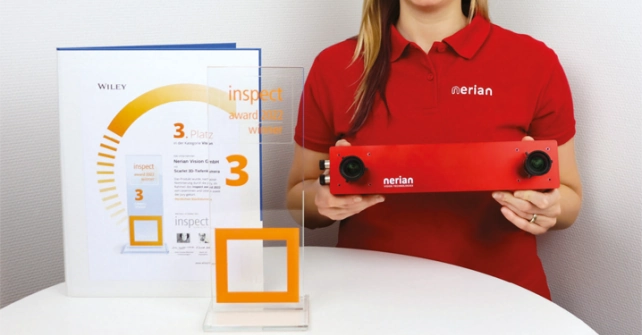
The Scarlet sensor – designed for extremely high-performance applications – earned Nerian the 2022 inspect award. Scarlet was capable of processing an impressive 70 million 3D points per second, setting new standards in real-time stereo vision.